Pianos are popping up all over town. The first one I saw was painted red by the girls of Young Women Writing for (a) Change, co-coordinating with our Shepard Fairey mural: Jewish and Palestinian Women Writing for (a) Change.
Last week, I encountered a blue piano at the Jewish Community Center not unlike the upright Dad hauled home and installed in our dining room when I was seven.
Ours had been a player piano, battered relic of the Knights of Pythias lodge where my father's union met weekly in those days. The player mechanism no longer existed, but the keys and strings did. So, for the price a case of beer for the buddies who helped Dad haul it home, we were in business.
My parents painted the piano blue to match the dining room walls and sent me weekly with fifty cents in a knotted hankie to Mrs. Trimble for lessons.
This is not a story about how I achieved success in music, thus repaying my parents' investment. Not that big story, no. But this smaller, less often told, and, I think--as important-- story. This is a story about how I learned from my parents what Albert Einstein more famously said: "not everything that counts can be counted."
Mom and Dad were raised poor: she a first-generation Italian, share-cropper in the Mississippi Delta; he a book-loving coal miner from
Southeastern Ohio. She was yanked out of sixth grade by her grandfather when she spoke of schoolmates taunting Dago, WOP, and more. He left high school to join the Civilian Conservation Corps, sending money home to feed the family during a mine shut-down.
Clear to me and to my brothers is that these experiences taught them to teach us "education is something they can never take away from you." It was one of the few things I'd say they harped on, besides not thinking the world owes you a living.
I played the blue piano for joy and for my parents' joy at hearing me. Eventually, I played the jazz standards my father loved, as do I to this day. My mother was not a music lover but she loved all things Roman Catholic, and in grade six I translated my (quite modest) talents into playing the organ and singing at church summers when "the music nun" went back to the Motherhouse.
My voice flew out of me like a freed bird those dark mornings in the choir loft, and while singing and playing the blue piano in our blue dining room. Valuing what came from inside taught me early what writing has taught me long and late: that I am someone, and at the same time, through practice and discipline-- I can become someone sharing my gifts in community.
Bless you, Blue Piano, and all the multi-colored others. Above all bless the vision and investment of those who carried you into our lives.
Mary Pierce Brosmer, author of Women Writing for (a) Change: A Guide for Creative Transformation, is Owner of Consulting for (a) Change.
Anonymous // Aug 26, 2010 at 9:01 pm
Pianos are popping up all over town. The first one I saw was painted red by the girls of Young Women Writing for (a) Change, co-coordinating with our Shepard Fairey mural: Jewish and Palestinian Women Writing for (a) Change.
Last week, I encountered a blue piano at the Jewish Community Center not unlike the upright Dad hauled home and installed in our dining room when I was seven.
Ours had been a player piano, battered relic of the Knights of Pythias lodge where my father's union met weekly in those days. The player mechanism no longer existed, but the keys and strings did. So, for the price a case of beer for the buddies who helped Dad haul it home, we were in business.
My parents painted the piano blue to match the dining room walls and sent me weekly with fifty cents in a knotted hankie to Mrs. Trimble for lessons.
This is not a story about how I achieved success in music, thus repaying my parents' investment. Not that big story, no. But this smaller, less often told, and, I think--as important-- story. This is a story about how I learned from my parents what Albert Einstein more famously said: "not everything that counts can be counted."
Mom and Dad were raised poor: she a first-generation Italian, share-cropper in the Mississippi Delta; he a book-loving coal miner from
Southeastern Ohio. She was yanked out of sixth grade by her grandfather when she spoke of schoolmates taunting Dago, WOP, and more. He left high school to join the Civilian Conservation Corps, sending money home to feed the family during a mine shut-down.
Clear to me and to my brothers is that these experiences taught them to teach us "education is something they can never take away from you." It was one of the few things I'd say they harped on, besides not thinking the world owes you a living.
I played the blue piano for joy and for my parents' joy at hearing me. Eventually, I played the jazz standards my father loved, as do I to this day. My mother was not a music lover but she loved all things Roman Catholic, and in grade six I translated my (quite modest) talents into playing the organ and singing at church summers when "the music nun" went back to the Motherhouse.
My voice flew out of me like a freed bird those dark mornings in the choir loft, and while singing and playing the blue piano in our blue dining room. Valuing what came from inside taught me early what writing has taught me long and late: that I am someone, and at the same time, through practice and discipline-- I can become someone sharing my gifts in community.
Bless you, Blue Piano, and all the multi-colored others. Above all bless the vision and investment of those who carried you into our lives.
Mary Pierce Brosmer, author of Women Writing for (a) Change: A Guide for Creative Transformation, is Owner of Consulting for (a) Change.
Heather // Aug 26, 2010 at 6:33 pm
Our last stop of the day... making it up to 25 pianos - so far!
Jeremy Stevenson // Aug 16, 2010 at 6:50 pm
Tenth stop- quite disappointing, but probably mainly due to the weather. This one is outside of the "Women Writing for (a) Change" building in Silverton. It had just rained, and the lawn you had to walk through to get there was full of deep puddles. Then the piano itself was waterlogged, over a whole tone flat, and the cloth-covered cushion on the bench was soaked. Didn't do much here except have my two boys play a few notes with me.
Kathy Wade // Aug 10, 2010 at 12:32 pm
Decorating our piano was fun! It's magnetic paint, so we can attach magnetic poetry to it. Katherine Meyer, our visiting artist for the summer, inspired the girls and teen in our summer writing camp to paint the piano. We hope lots of people come and make music at Women Writing for a Change!


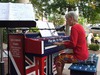





Last week, I encountered a blue piano at the Jewish Community Center not unlike the upright Dad hauled home and installed in our dining room when I was seven.
Ours had been a player piano, battered relic of the Knights of Pythias lodge where my father's union met weekly in those days. The player mechanism no longer existed, but the keys and strings did. So, for the price a case of beer for the buddies who helped Dad haul it home, we were in business.
My parents painted the piano blue to match the dining room walls and sent me weekly with fifty cents in a knotted hankie to Mrs. Trimble for lessons.
This is not a story about how I achieved success in music, thus repaying my parents' investment. Not that big story, no. But this smaller, less often told, and, I think--as important-- story. This is a story about how I learned from my parents what Albert Einstein more famously said: "not everything that counts can be counted."
Mom and Dad were raised poor: she a first-generation Italian, share-cropper in the Mississippi Delta; he a book-loving coal miner from
Southeastern Ohio. She was yanked out of sixth grade by her grandfather when she spoke of schoolmates taunting Dago, WOP, and more. He left high school to join the Civilian Conservation Corps, sending money home to feed the family during a mine shut-down.
Clear to me and to my brothers is that these experiences taught them to teach us "education is something they can never take away from you." It was one of the few things I'd say they harped on, besides not thinking the world owes you a living.
I played the blue piano for joy and for my parents' joy at hearing me. Eventually, I played the jazz standards my father loved, as do I to this day. My mother was not a music lover but she loved all things Roman Catholic, and in grade six I translated my (quite modest) talents into playing the organ and singing at church summers when "the music nun" went back to the Motherhouse.
My voice flew out of me like a freed bird those dark mornings in the choir loft, and while singing and playing the blue piano in our blue dining room. Valuing what came from inside taught me early what writing has taught me long and late: that I am someone, and at the same time, through practice and discipline-- I can become someone sharing my gifts in community.
Bless you, Blue Piano, and all the multi-colored others. Above all bless the vision and investment of those who carried you into our lives.
Mary Pierce Brosmer, author of Women Writing for (a) Change: A Guide for Creative Transformation, is Owner of Consulting for (a) Change.
Last week, I encountered a blue piano at the Jewish Community Center not unlike the upright Dad hauled home and installed in our dining room when I was seven.
Ours had been a player piano, battered relic of the Knights of Pythias lodge where my father's union met weekly in those days. The player mechanism no longer existed, but the keys and strings did. So, for the price a case of beer for the buddies who helped Dad haul it home, we were in business.
My parents painted the piano blue to match the dining room walls and sent me weekly with fifty cents in a knotted hankie to Mrs. Trimble for lessons.
This is not a story about how I achieved success in music, thus repaying my parents' investment. Not that big story, no. But this smaller, less often told, and, I think--as important-- story. This is a story about how I learned from my parents what Albert Einstein more famously said: "not everything that counts can be counted."
Mom and Dad were raised poor: she a first-generation Italian, share-cropper in the Mississippi Delta; he a book-loving coal miner from
Southeastern Ohio. She was yanked out of sixth grade by her grandfather when she spoke of schoolmates taunting Dago, WOP, and more. He left high school to join the Civilian Conservation Corps, sending money home to feed the family during a mine shut-down.
Clear to me and to my brothers is that these experiences taught them to teach us "education is something they can never take away from you." It was one of the few things I'd say they harped on, besides not thinking the world owes you a living.
I played the blue piano for joy and for my parents' joy at hearing me. Eventually, I played the jazz standards my father loved, as do I to this day. My mother was not a music lover but she loved all things Roman Catholic, and in grade six I translated my (quite modest) talents into playing the organ and singing at church summers when "the music nun" went back to the Motherhouse.
My voice flew out of me like a freed bird those dark mornings in the choir loft, and while singing and playing the blue piano in our blue dining room. Valuing what came from inside taught me early what writing has taught me long and late: that I am someone, and at the same time, through practice and discipline-- I can become someone sharing my gifts in community.
Bless you, Blue Piano, and all the multi-colored others. Above all bless the vision and investment of those who carried you into our lives.
Mary Pierce Brosmer, author of Women Writing for (a) Change: A Guide for Creative Transformation, is Owner of Consulting for (a) Change.